I am a huge technophile, and as a result probably have one of the most wired dorm rooms out there. I never seem to have enough though, and am constantly expanding and adding things. So, this information is only current to the date updated below.
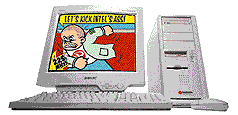 I suppose my computer is now a collectors item now that the company is out of business (the ad on the right is definately a memory of old times). It is one of the first shipping Power Computing PowerTower Pro 200 systems. It is a Mac (PM 9500) compatible, running a PowerPC 604e at 200 MHz. It was rocket fast back in the summer of '96 when I got it, and it still competes with the faster systems now, so I can't complain. RAM is currently up to 144 MB, plus the original 1 MB of L2 cache. I currently spins up four hard drives: Two IBM UltraStar XP 7400rpm A/V drives at 2 gigs each, my good ol' 1 gig Quantum Fireball, and a Fujitsu M2949 MR 7200rpm 9.1 drive. 14 gigs? Never enough. Where does the excess data go? On CD-Rs of course, with my Pinnacle Micro RCD-100, the first CD-R on the market. It may be 1x, but I've never had a bad burn. CD-ROMs are played in my AppleCD 1200i 8x drive (not the junky NEC that came with the machine). I still have my old 105 MB SyQuest drive, the free internal 100 MB Zip that came with the machine, and the floppy drive, but those never get used. Drive bays are my friend. I have 6 PCI slots, but at least that part of the system isn't packed yet. Video comes from the IMS (now IXMicro) TwinTurbo M8 8-Meg video card, from times when 3D cards were unheard of, and the norm for VRAM was a meg or two. It still has unbeatable 2-D, but to help it with, well, Quake, the TechWorks Power3D adds a little 3dFX Voodoo-1 punch. And who wants to bring up a TV to college? Not me, I instead use IXMicro's TurboTV TV tuner card.
All of that in one box! No wonder I can hardly lift it... Out of the box peripherals give me all the input and output I can think of. Apple's unreplaceable Apple Extended Keyboard II, the only quality keyboard these days (explains the $150 price tag), and Apple Desktop Bus Mouse II, along with the Touché touch pad, provide hand-based input. Voice input comes from Apple's PlainTalk mic. An Artec ViewStation AT3 300x600 24-bit flatbed scanner and a Connectix Color QuickCam provide visual input. Paper output is provided by Epson's excellent Stylus Color 600 1400x720 dpi color inkjet printer. And the newest addition is the ultimate in monitors: The Apple Studio Display 15.1" flat panel display.
On to Video. If you haven't figured it out already, I don't do analog. No VCR or tape teck here. My movie collection is on DVD (see my DVD page). Pioneer's DV-500 DVD player sits underneath my Studio Display, connected to it via S-Video.
Everything is hooked into my stereo, which is perfectly set up in 6-speaker surround sound (Regretably Dolby Pro-Logic, Dolby Digital just missed the cut when I made my stereo puchase). An AIWA AV-X300 component system reciever with built-in 5 CD changer pumps out a total of 500 Watts to my Advent/Yamaha satellite/passive sub system. Perfect for watching those sci-fi DVDs.
The last few items fill my radio communications intrests. A Uniden EXP-9200 Digital Spread Spectrum 900 MHz 2-line portable speakerphone, still going strong after five years. RadioShack's Pro-64 handheld 400 channel scanner lets me see what the dorm custodians are really up to. And last but definately not least, Sony's Z-Phone digital PCS cell phone with SprintPCS service lets me read my email and take phone calls on the go.
If you've made it this far and actually understand every number and acronym here, you probably have just as rediculous a system as I do. If not, don't worry about it, numbers and acronyms are actually a separate language in some areas. : )